
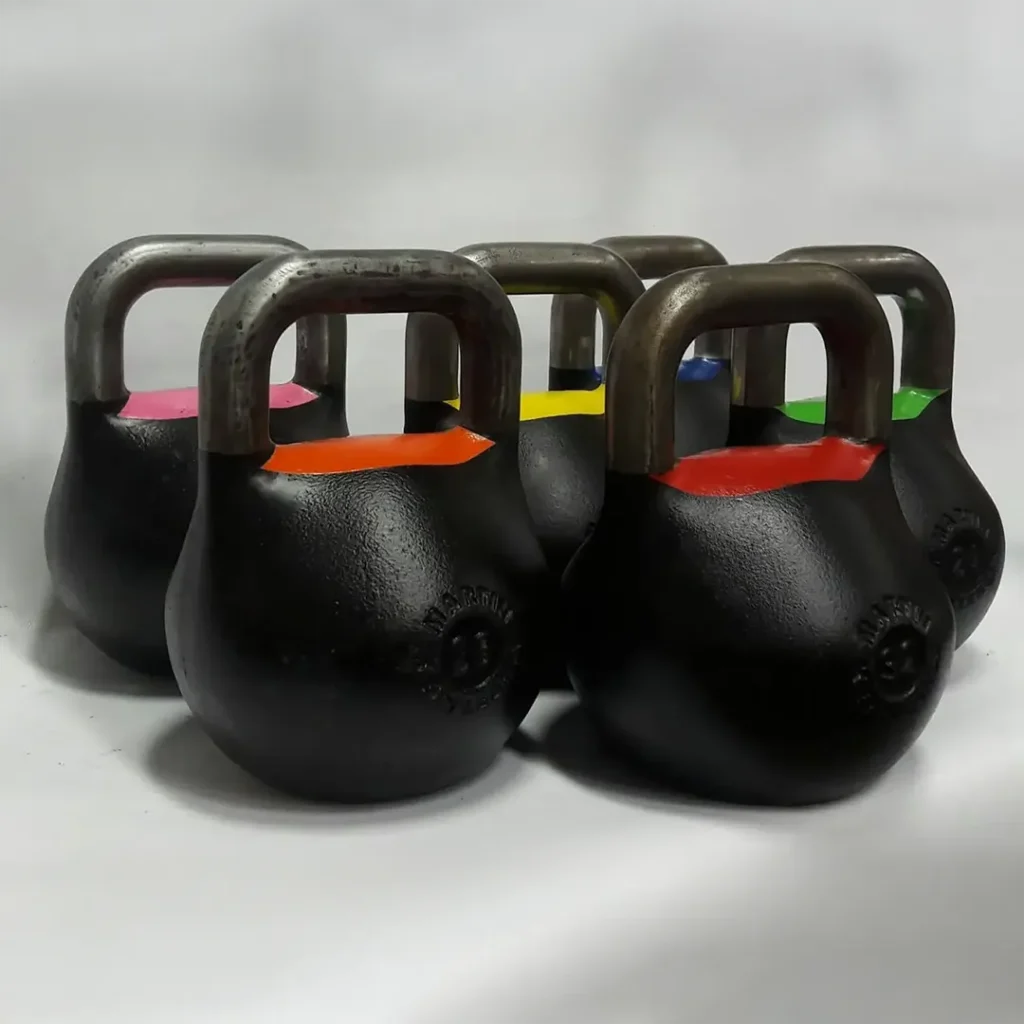
Martin Kettlebell: What Sets Them Apart from Traditional Kettlebells
A kettlebell is a ball with a handle. At least, that’s what it looks like at first glance. However, anyone who regularly trains with swings, cleans, snatches, or presses quickly realizes how much form, center of gravity, and grip influence the workout.
It is precisely in these areas that the Martin Kettlebell was designed differently.
According to the manufacturer, Johann Martin and Mark Dorninger spent more than three years developing it. The goal was not to create a visually new variation of a familiar kettlebell, but rather a redesigned competition kettlebell that specifically improved the rack position, pressure on the forearm, center of gravity, and handling.
The result is particularly noticeable during exercises where the kettlebell makes direct contact with the forearm. Anyone who has ever performed many cleans, snatches, or presses with a classic competition kettlebell knows that, after a few dozen repetitions, even small differences in design can become very apparent.
So what makes the Martin Kettlebell different?
1. The flattened shape distributes pressure more evenly
One of the most noticeable differences from the classic round kettlebell is its flattened sides.
During a clean or press, the kettlebell rests against the forearm or upper arm in the rack position. With a highly rounded shape, this contact is concentrated on a relatively small area. Depending on technique, physique, and weight, this can create an uncomfortable pressure point.
The Martin Kettlebell was modified precisely in this area. Its ergonomically optimized shape is designed to distribute pressure over a larger area of the upper forearm. The manufacturer explicitly cites the reduction of these typical pressure points as one of the key development goals.
This is particularly relevant for exercises in which the kettlebell rests against the body for an extended period or repeatedly returns to the same position.
In the clean, the kettlebell lands in the rack position. In the press, it starts there. In the jerk and long cycle, this position is assumed repeatedly. And in the snatch, the kettlebell must be guided in a controlled manner into the top position.
The more repetitions you do, the more important it becomes to have a design that sits comfortably against your body.
2. The rack position has been specifically improved
In kettlebell training, the rack position is far more than just a brief stop along the way.
In exercises such as the clean & press, jerk, or long cycle, it serves as a central working and recovery position. The kettlebell should rest as stably as possible against your body without requiring you to expend unnecessary effort to hold it there.
This is exactly where a second design feature of the Martin Kettlebell comes into play: its shifted center of gravity.
The hollow kettlebell body shifts the center of gravity further toward the handle. According to the manufacturer, this improves both the kettlebell’s ballistics and its position against the body.
At first, this may sound like a technical detail. In training, however, it’s easy to understand: The better a kettlebell balances in its intended position, the less you have to work against the weight.
This can make a significant difference in how the workout feels, especially during longer sets.
3. The shifted center of gravity changes the handling
With a kettlebell, the weight is located outside the hand. This is precisely what distinguishes it from a dumbbell, for example, and makes many typical kettlebell movements possible in the first place.
Where the center of gravity is located within the ball also influences how the kettlebell behaves during the movement.
With the Martin Kettlebell, the center of gravity was deliberately shifted toward the handle. Kettlebell.eu describes the following benefits of this:
Martin Kettlebell vs. Classic Kettlebell
Feature | Martin Kettlebell | Many classic models |
Body Shape | Ergonomically flattened sides | More rounded design |
Rack Position | Designed for a wider contact surface | Depending on the shape, often more localized contact |
Center of Gravity | shifted toward the handle | More toward the ball |
Core | Hollow | Solid or filled, depending on the model |
Handle | Precise 35-mm handle | Diameter varies by model |
Surface | Powder coating | Varnish, powder coating, or untreated handle |
Size for different weights | Competition design with consistent shape | Fitness kettlebells often increase in size |
The key point here is that not every classic kettlebell automatically possesses all the characteristics listed in the right-hand column. High-quality competition kettlebells, in particular, also offer excellent handling. The Martin Kettlebell stands out primarily due to the combination of its ergonomic shape, its shifted center of gravity, and the resulting rack position.
4. 35-mm handle for a consistent grip
The handle is one of the areas where a good kettlebell quickly stands out from an unsuitable model.
If it’s too thick, grip strength fatigues unnecessarily quickly. If the surface is too smooth, the kettlebell becomes harder to control during high-intensity workouts. Unfavorable transitions between the handle and the ball can, in turn, interfere with cleans and snatches.
The Martin Kettlebell has a handle diameter of 35 millimeters with a specified manufacturing tolerance of plus or minus 0.5 millimeters.
The 35-mm handle is modeled after competition kettlebells and remains consistent across all weight classes.
This offers a practical advantage for technique.
For example, if you start by training with a 12-kilogram kettlebell and later switch to 16, 20, or 24 kilograms, the overall geometry of the training equipment does not change. Your hands will continue to grip the same handle diameter.
Those who train over the long term, in particular, benefit from this consistency.
5. Consistent Shape Even When Changing Weights
With many traditional fitness kettlebells, the size of the ball increases as the weight increases.
A light kettlebell can be relatively small, while a significantly heavier model is much larger. This is usually not a major problem for simple swings. However, for more technically demanding movements, this changes the way the kettlebell handles.
Suddenly, the kettlebell feels different against the forearm. The distance between the hand and the ball changes. The rack position feels different.
Competition kettlebells fundamentally solve this problem by keeping their outer shape largely consistent across different weight classes. The Martin Kettlebell also follows this principle. Kettlebell.eu therefore explicitly cites the uniform ball size as an advantage for technical training and competition use.
This allows you to get stronger without having to constantly adjust your technique to a new ball shape.
This point isn’t just relevant for competitive athletes. Beginners also benefit when movement patterns remain consistent.
6. Powder Coating Instead of a Smooth Paint Finish
Kettlebell training involves sweat, friction, and contact with the floor or other kettlebells. The surface must therefore be able to withstand a fair amount of wear and tear.
The Martin Kettlebell features a durable powder coating. The manufacturer highlights this feature for both its durability and the secure grip it provides.
The difference compared to very smooth, painted surfaces is particularly noticeable during longer training sessions.
A kettlebell shouldn’t become harder to control just because your hands are sweaty. At the same time, the surface shouldn’t be so rough that it creates unnecessary friction during high-rep sets.
This balance is especially important for snatches, cleans, and longer swing sets.
What does the hollow body mean?
Another unusual feature is the design of the kettlebell’s body.
The Martin Kettlebell is made of ductile iron and has a hollow core. This allows for precise control over weight distribution. As a result, this design is a key reason why the center of gravity is closer to the handle.
This sets it apart from kettlebells whose weight is primarily concentrated deep within the solid spherical body.
For the user, the internal structure is less important. What matters is the effect this has on the exterior: the kettlebell is designed to feel more balanced in rack and overhead positions.
For the currently available models up to 32 kilograms, the manufacturer also states that they are lead- and nickel-free. For the 36- and 40-kilogram models, lead is used in the inner core to provide the additional weight.
Where are the differences most noticeable?
During a simple deadlift, the special shape of the Martin kettlebell naturally plays a minor role. The sphere barely comes into contact with the forearm or shoulder and moves along a relatively simple path.
The design becomes significantly more interesting during dynamic and technically more demanding exercises.
Clean
During the Clean, the kettlebell should not strike the forearm with full force. Form and center of gravity influence how it moves around the hand and subsequently settles into the rack position.
This is where the flattened contact surface and the shifted center of gravity demonstrate their greatest strengths.
Press and Jerk
For the Press and Jerk, the movement begins from the rack position and ends overhead.
A stable starting position reduces unnecessary tension. At the same time, the higher center of gravity is designed to support stability in the overhead position. Kettlebell.eu explicitly cites relief for the back and shoulders, as well as improved overhead stability, as the goals of the design.
Snatch
In the Snatch, the kettlebell moves in a dynamic motion from the swing directly overhead.
The grip, rotation around the hand, and controlled landing on the forearm are crucial here. Especially with high rep counts, small ergonomic differences make a big difference in how the workout feels.
Long Cycle
In the Long Cycle, the Clean and Jerk are combined over many repetitions.
This results in a constant alternation between dynamic movement and the rack position. The very characteristics for which the Martin Kettlebell was developed come into play particularly frequently here.
Is the Martin Kettlebell intended only for competitive athletes?
No.
The term “competition kettlebell” can easily give the impression that such a model is only useful for athletes who actually compete.
In practice, however, beginners also benefit from a standardized design.
Those who train from the start with consistent geometry won’t have to adjust to a new kettlebell size the next time they increase the weight. The 35-mm handle also remains familiar.
For beginners, there’s another benefit: a more comfortable rack position can help them focus more on their actual technique instead of worrying about uncomfortable pressure points on their forearms.
Advanced athletes, on the other hand, benefit more from the finer details during longer sets, cleans, snatches, presses, and complex combinations.
Martin Kettlebell or Classic Competition Kettlebell?
A high-quality classic competition kettlebell is also a professional training tool.
The Martin Kettlebell therefore does not attempt to reinvent the competition concept. Rather, it modifies a few aspects of the classic design that can be perceived as problematic in practice.
The biggest difference is the shape of the kettlebell head.
While traditional competition kettlebells have a more rounded design, the Martin Kettlebell features characteristic flattened areas. Added to this is the altered weight distribution due to the hollow core.
Those who mainly do swings or goblet squats will notice this difference less.
On the other hand, those who regularly train with clean & press, snatches, jerks, or long cycles will encounter these specific design features much more frequently.
This makes the Martin Kettlebell particularly interesting for technically oriented training.
Why was the Martin Kettlebell developed in the first place?
There’s more to this kettlebell than just a new product color or a different logo.
Johann Martin is introduced on kettlebell.eu as a longtime barbell and kettlebell athlete and the developer of the “Competition Kettlebell 2.0.” According to the product description, he and Mark Dorninger spent more than three years developing the Martin Kettlebell.
Who will particularly benefit from the Martin Kettlebell?
The Martin Kettlebell is especially useful if you want to do more than just occasional swings.
If you regularly train cleans, presses, or snatches, the rack position becomes much more important. If you gradually increase the weight, consistent form is an advantage. If you train with high rep counts, pressure points and grip feel become more relevant. And if you’re preparing for technically demanding workouts or kettlebell sport, balance and consistent handling play a bigger role.
On the other hand, if you’re simply looking for the most affordable kettlebell possible for occasional deadlifts or goblet squats, you don’t necessarily need many of these features.
That’s also the most sensible criterion when buying: It’s not the longest list of features that matters, but whether the design suits your training.
Frequently Asked Questions About the Martin Kettlebell
What makes the Martin Kettlebell special?
The key differences are the ergonomically shaped spherical body with flattened sides, the rack position designed for it, the center of gravity shifted toward the handle, the hollow core, the precision-engineered 35-mm handle, and the powder-coated finish.
Why is the Martin kettlebell flattened on the sides?
The design is intended to increase the contact area on the upper forearm. As a result, the pressure is distributed more evenly across a larger area during the rack position, press, and snatch, rather than being concentrated on a single point.
What are the benefits of shifting the focus?
Durch den hohlen Kettlebell-Körper liegt der Schwerpunkt stärker in Richtung Griff. Das soll die Ballistik sowie die Rack- und Overhead-Position verbessern.
Does the Martin Kettlebell have a competition grip?
Yes. According to the manufacturer, the handle diameter is 35 millimeters, with a tolerance of plus or minus 0.5 millimeters.
Is it also suitable for beginners?
Yes. The consistent design can actually be helpful for beginners because it means the feel of the bar changes less when they later move on to heavier weights.
Which exercises are particularly suitable?
The design advantages are particularly evident during exercises performed in rack or overhead positions—such as the clean, press, jerk, snatch, and long cycle. Swings, squats, carries, and other classic exercises are also possible.
Is the Martin kettlebell better than any other kettlebell?
That depends on the intended use. It’s not really possible to call any one kettlebell the “best” for everyone, regardless of the type of workout. Compared to many traditional models, however, the Martin Kettlebell has specific design differences in terms of shape, center of gravity, and rack position. These characteristics can offer a noticeable advantage, especially during technically demanding exercises.
A kettlebell that’s been modified in all the right places
The Martin Kettlebell doesn’t try to turn a tried-and-true training tool into something completely different.
The handle, competition-style construction, and consistent feel remain unchanged. Instead, the modifications focus on the areas that become particularly important during regular training: the forearm rest, the rack position, and the weight distribution.
The flattened sides distribute pressure over a larger area. The hollow core shifts the center of gravity closer to the handle. The 35-mm handle ensures a consistent grip, and the powder-coated surface is designed for intensive use. It is precisely this combination that sets the Martin Kettlebell apart from many classic kettlebells.
If you use your kettlebell mainly for a few occasional exercises, you don’t necessarily need every one of these features. However, if you regularly perform cleans, snatches, presses, or longer kettlebell sets, you’ll quickly realize why ergonomics in a kettlebell is more than just a matter of design.